Chatoner Enterprise AI · Established operations pathway
Improve what your organization already operates.
Start with an operating opportunity scan. Map the workflow, people, systems, data, controls, adoption, and evidence before selecting the exact capability bundle and entry stage.
Established operation firstHuman authority stays visiblePilot evidence before scale
Structured, not speculative. The public scan uses deterministic answer IDs and fixed rules—no AI model, semantic matching, or hidden external classification.
01
Established operationThe current work is the starting point
02
Client-approved systemsNo hidden parallel record
03
Human authorityDecision rights remain visible
04
Pilot evidenceProve before scale
Begin with the operating result
DonotstartwithanAIformat.Startwiththechange.
Discovery maps the current people, tools, systems, data, volume, handoffs, exceptions, ownership, risk, and baseline before deciding what should be changed.
Enterprise AI can serve Small and Medium Enterprises, Corporations, organizations, NGOs, and Public Institutions when the work improves established operations. Organization size alone does not decide the route.
Outcome 01
Move work with fewer manual handoffs
Connect triggers, tasks, approvals, exceptions, and evidence so work advances without hiding responsibility.
Outcome 02
Give teams better operating leverage
Support people with approved knowledge, drafts, triage, monitoring, and bounded actions while specialists retain authority.
Outcome 03
Connect fragmented systems
Create a coherent service layer across client-approved applications, data, channels, identity, and operational records.
Outcome 04
Make measurable change visible
Define the baseline, pilot evidence, operating measures, quality, adoption, and review rhythm before scaling.
Six connected capabilities
Onepathwaycomposesonlywhattheworkrequires.
Enterprise AI is not a seventh capability. It combines the current capability catalogue around one approved operating outcome, environment, owner, baseline, and evidence plan.
AI connected deliveryStrategy, systems, workflows, agents, governance, and operations around one approved outcome.
01
Connected Enterprise capability
AI Strategy & Consultancy
Identify the right opportunities before deciding what to build.
Assess goals, workflows, data, tools, risks, readiness, and expected value before deciding what should be improved, automated, built, or left unchanged.
Build around the organization’s actual operating environment.
Design and implement connected AI systems around the client’s approved processes, tools, data, integrations, permissions, owners, and operating outcomes.
Build purpose-specific agents that interpret context and take approved actions within defined responsibilities, permissions, tools, knowledge, escalation, and review limits.
The complete original scan now maps organization context, outcomes, workflow maturity, systems, integrations, data, AI authority, risk, deployment, adoption, pilot evidence, and the accountable next action.
Complete original opportunity scan
Operational depth without replacing the restored page.
The existing Enterprise hero, capability imagery, outcome cards, operating map, 5D lifecycle, governance controls, and guidance remain in their established visual language.
Chatoner Enterprise AI · established operations pathway · AI Co-founder ↗
Improve what your organizationalready operates.
Start with an operating opportunity scan—not a generic AI services list. Small and Medium Enterprises, Corporations, NGOs, and Public Institutions can map the workflow, people, systems, data, controls, adoption, and evidence before Chatoner recommends the exact capability bundle and entry stage.
Do not start with an AI format. Start with the change.
Enterprise AI earns its place when it improves a real service, workflow, decision, knowledge function, or system—and the organization can prove the difference.
01
Move work with fewer manual handoffs
Connect triggers, tasks, approvals, exceptions, and evidence so work advances without hiding responsibility.
02
Give teams better operating leverage
Support people with approved knowledge, drafts, triage, monitoring, and bounded actions while specialists retain authority.
03
Connect fragmented systems
Create a coherent service layer across client-approved applications, data, channels, identity, and operational records.
04
Make measurable change visible
Define the baseline, pilot evidence, operating measures, quality, adoption, and review rhythm before scaling.
Six connected capabilities
Use the capability mix the operation actually needs.
The scan can recommend several capabilities together. Strategy, systems, automation, digital workers, agents, and governance remain connected from discovery through operation.
CONNECTED DELIVERYStrategy, systems, workflows, agents, governance, and operations around one approved outcome.
01 · CHATONER AI SYSTEMS
AI Strategy & Consultancy
Clarify the operating problem, evidence, process, opportunity, business case, scope, risk, adoption, and the right first proof.
Find the right intervention before commissioning the wrong system.
Answer one structured question at a time. The scan recommends a route, entry stage, primary capabilities, supporting capabilities, governance overlay, readiness, gaps, and next action.
Structured operating intake
Map the opportunity in the language of the operation.
The scan covers organization context, object of change, operating outcomes, workflow maturity, systems, data, AI authority, risk, deployment, adoption, pilot evidence, and the responsible next action.
NO AI MODEL USED
EXPERIENCEOne decision at a timeRESULTMulti-capability bundleSTATESaved in this browser
Enterprise AI remains connected from operating evidence to production ownership. Each phase has explicit decisions, evidence, human gates, and a credible exit condition.
01
Discover
Map the operation, owners, users, evidence, constraints, systems, data, risk, measures, and the smallest valuable opportunity.
02
Design
Define the future workflow, experience, architecture, AI role, permissions, approvals, exceptions, pilot, and acceptance criteria.
03
Develop
Build the approved components, integrations, data services, workflows, agents, tests, evaluation, and operational evidence.
04
Deploy
Run a controlled pilot, review findings, approve changes, deploy into the approved environment, and complete handover.
05
Drive
Support adoption, monitor outcomes, operate controls, manage incidents and change, improve performance, and measure value.
Operate the whole journey
Design the happy path—and the real exceptions.
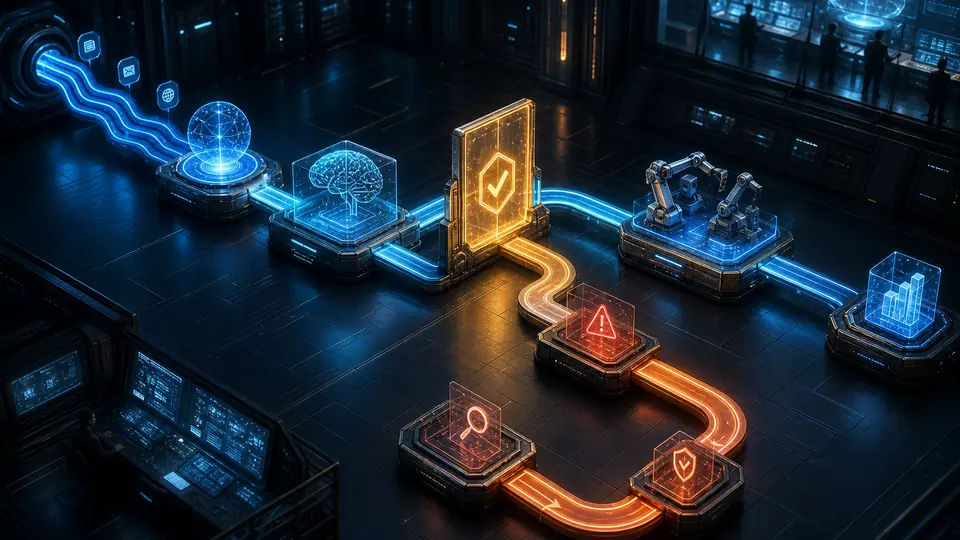
Enterprise work is not only a sequence of ideal steps. It needs missing-data routes, retries, approval gates, timeouts, policy conflicts, human escalation, rollback, audit, and named ownership.
✓ Approved system actions—not a hidden parallel record
✓ Human approval before consequential actions
✓ Evidence for every material decision and change
✓ Failure, fallback, recovery, and safe-stop behaviour
TRIGGERRequest received
→
CONTROLLED WORKRetrieve · prepare · route
→
APPROVED ACTIONUpdate client-approved system
!
Information incompleteRequest the missing evidence or route to a named human owner.
ESCALATE↻
Integration unavailableApply bounded retry, record the failure, and use the approved fallback.
RECOVER✓
Consequential action readyPause behind the configured human approval and retain the evidence.
APPROVE■
Risk or policy conflictStop the action, alert the owner, and preserve the audit context.
SAFE STOP
Choose the correct front door
New product or established operation?
The same organization can use both pathways for different work. The deciding factor is the primary object of change.
AI CO-FOUNDER
Build something materially new.
Use when the main task is a new venture, product, platform, business, or distinct internal product with its own users and release journey.
Use when the main task is an established workflow, customer journey, knowledge function, system landscape, or organization-wide adoption model.
Operating baseline and measurable change
Existing systems, data, people, and controls
Governed pilot, deployment, adoption, and value
Governed by design
Human authority is not a final checkbox.
Put ownership, approved data, role-based access, source evidence, model and prompt versions, human approvals, incident routes, safe-stop authority, change control, and production responsibility into the system design.
Enterprise operating control plane Controls active01
Decision rightsSponsor, product owner, data owner, risk owner, technical owner, and production approver
Named02
Data boundaryApproved sources, purposes, access, retention, deletion, and environment
Controlled03
AI authorityAllowed, prohibited, approval-required, fallback, escalation, and override actions
Bounded04
EvidenceRequirements, tests, evaluation, approvals, versions, incidents, and changes
Traceable05
OperationsMonitoring, support, recovery, maintenance, adoption, value review, and renewal
Owned
Frequently asked questions
Clear boundaries before delivery begins.
Use the scan to prepare the conversation, then validate the result with the people who own the workflow, data, risk, budget, and production environment.
01How is Enterprise AI different from AI Co-founder?+
Enterprise AI improves an established operation, workflow, customer journey, institution, or system. AI Co-founder is for a materially new venture, product, platform, or business. Organization size does not decide the route; the main object of change does.
02Does the scan use an AI model?+
No. The scan uses structured answer IDs, explicit tags, deterministic scoring, fixed route rules, and prewritten explanations. The same answers and ruleset version return the same result.
03Does Chatoner provide a provider-owned CRM or take ownership of our systems?+
No. Chatoner integrates with client-approved systems and deploys into the approved environment. CRM actions are recorded in the client-approved CRM or operating system; Chatoner does not describe a hosted customer-record workspace as the default.
04Can the result recommend several Chatoner capabilities?+
Yes. Enterprise opportunities rarely fit one isolated service. The scan identifies one or two primary capabilities, supporting capabilities, and a mandatory governance overlay where the risk profile requires it.
05What happens when the opportunity is actually a new product?+
The result routes it to AI Co-founder and preserves the scan context for the next conversation. A large corporation may still use AI Co-founder when the work is a materially new venture or product.
06Does completing the scan approve a project, contract, or invoice?+
No. The scan produces an opportunity brief and next-step recommendation. It does not create a contract, invoice, project approval, data authorization, or production-deployment approval.
07Can Chatoner work with an existing technical team and infrastructure?+
Yes. The delivery model can be strategy-only, architecture, pilot, co-build, integration, review and improve, productionization, or full delivery. Infrastructure ownership and credentials remain explicit and client-approved.
08How is value measured?+
Discovery establishes the operating baseline, target measures, pilot evidence, acceptance criteria, adoption indicators, and review window. Modeled savings, revenue, quality, or adoption are not presented as proven outcomes.
Turn the operating problem into a controlled next move
Do not add AI beside a broken process.
Map the operation, choose the right capability mix, define human authority, and prove the change in a controlled pilot before scaling.
The scan is an initial structured assessment—not a contract, proposal, legal determination, or delivery guarantee.
The 5D delivery method
Discover.Design.Develop.Deploy.Drive.
Each stage keeps the operating baseline, owners, decisions, controls, evidence, acceptance, adoption, incident response, and recovery connected.
01
Discover
Map the operating problem, evidence, workflow, systems, owners, risks, baseline, and first useful proof.
02
Design
Define the future workflow, experience, architecture, data, approvals, exceptions, measures, and acceptance.
03
Develop
Build and integrate the approved system, workflow, worker, agent, governance, monitoring, and evidence.
04
Deploy
Pilot, validate, approve, release, hand over, establish safe-stop, recovery, and operating ownership.
05
Drive
Measure adoption and outcomes, review incidents and drift, improve safely, and decide what scales next.
Operate the whole journey
Designthehappypath—andtherealexceptions.
A credible system defines normal work, exceptions, approvals, evidence, failure, fallback, recovery, and safe-stop before production scale.
01 · Trigger
Request received
Identity, context, permission, purpose, and owner enter the workflow.
02 · Controlled work
Retrieve, prepare, and route
Approved knowledge, tools, rules, queues, and human checkpoints shape the work.
03 · Approved action
Update the client-approved system
The system of record, evidence, owner, status, and next step remain visible.
Approved system actions—not a hidden parallel recordHuman approval before consequential actionEvidence for every material decision and changeFailure, fallback, recovery, and safe-stop
Information incomplete
Escalate
Integration unavailable
Recover
Consequential action ready
Approve
Risk or policy conflict
Safe stop
Choose the correct front door
Newproductorestablishedoperation?
The route follows the main object of change—not company size, funding stage, or the fashionable AI format of the moment.
Materially new initiative
AI Co-founder
Choose this for a new venture, focused MVP, new product, separate platform, or product recovery with a new release boundary.
The scan is an initial assessment—not a legal determination, contract, proposal, delivery guarantee, or production authorization.
Enterprise AI improves an established operation, workflow, customer journey, institution, or system. AI Co-founder is for a materially new venture, product, platform, or business. Organization size does not decide the route; the main object of change does.
No. The scan uses structured answer IDs, explicit tags, deterministic scoring, fixed route rules, and prewritten explanations. The same answers and ruleset version return the same result.
No. Chatoner integrates with client-approved systems and deploys into the approved environment. CRM actions are recorded in the client-approved CRM or operating system.
Yes. Enterprise opportunities rarely fit one isolated service. The scan identifies primary and supporting capabilities, plus a governance overlay where the risk profile requires it.
The result routes it to AI Co-founder and preserves the scan context for the next conversation. A large corporation may still use AI Co-founder for a materially new venture or product.
No. It produces an opportunity brief and next-step recommendation. It does not create a contract, invoice, project approval, data authorization, or production-deployment approval.
Yes. Delivery can be strategy-only, architecture, pilot, co-build, integration, review and improve, productionization, or full delivery. Infrastructure ownership and credentials remain explicit and client-approved.
Discovery establishes the operating baseline, target measures, pilot evidence, acceptance criteria, adoption indicators, and review window. Modeled savings, revenue, quality, or adoption are not presented as proven outcomes.
Turn the operating problem into a controlled next move
Do not add AI beside a broken process.
Bring one workflow, system, customer journey, institution, or measurable operating outcome. Chatoner will map the smallest credible intervention and its evidence boundary.